Labels

Comments

I LOVE comments, so please, if you have an opinion or would like to ask a question, do so. But do check back as I shall answer any questions in the comments of the relevant post - that way, everyone can benefit from everybody's knowledge and advice.
Showing posts with label Herbs. Show all posts

Monday, 11 July 2011

Antiseptic Thyme

The thyme on the allotment was fabulous this year so just as it was about to come into bloom I picked a large handful and soaked it in sunflower oil.  I covered the bowl with clingfilm and left it for several weeks...


In fact I left it until my other half got quite shirty about it hanging around the kitchen - he assumed it was for something to eat... mmm... not sure what recipe that would be. But he's well used to me dreaming up not only lotions and potions but interesting food recipes too!


Finally I sorted myself out and found the time to do something with it.  I decided on a first aid balm because thyme is a wonderful antiseptic (and because I had no balm left in the cupboard).  In fact I have a recipe for curing duck breasts in salt and thyme which clearly states that you cannot leave the thyme out because of it's antibacterial properties. 

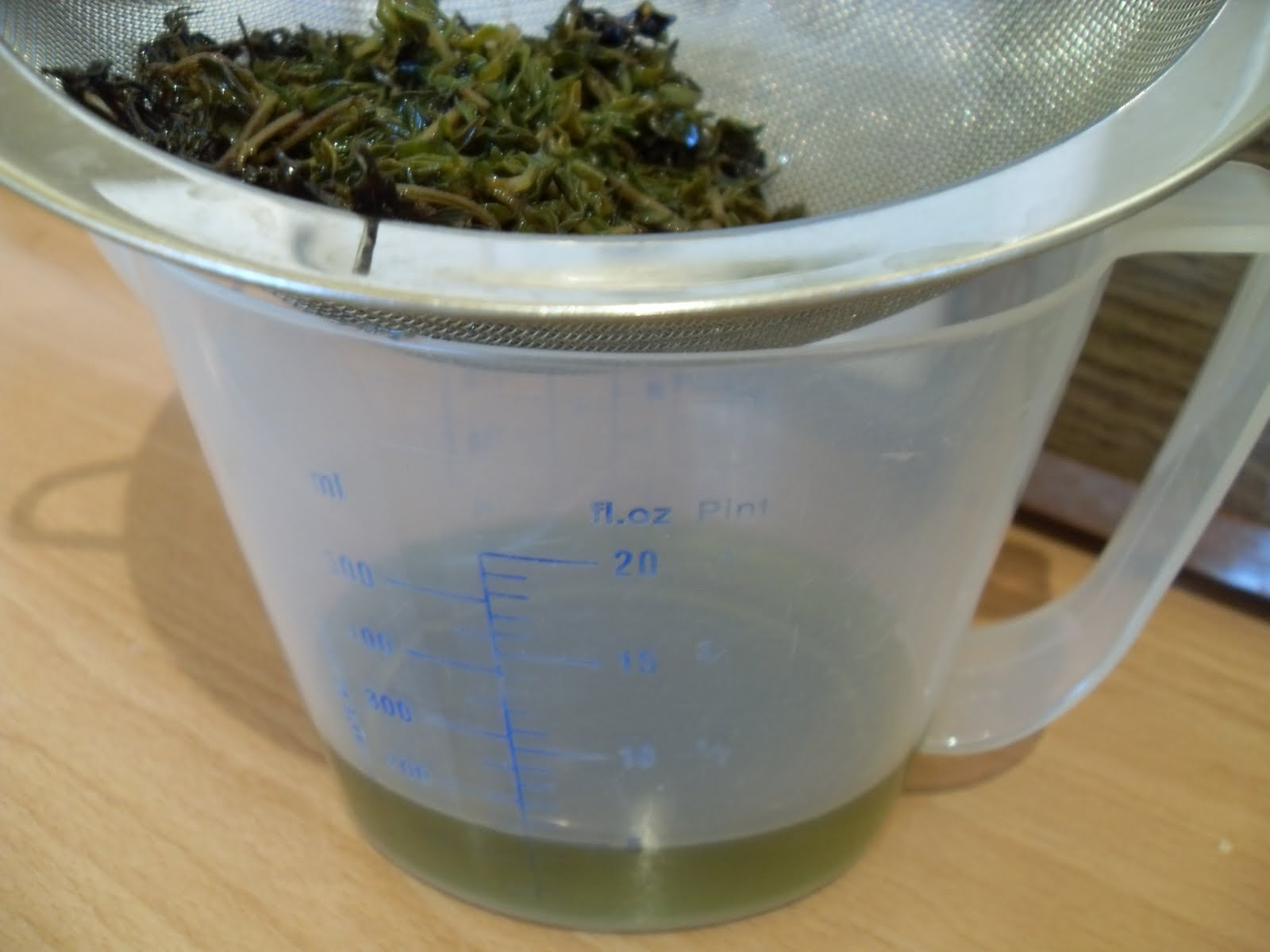
I strained the oil - for every 50ml you need 4gm of beeswax.  Look how green the sunflower oil has gone, it smelled interesting too... very much as you would expect an antiseptic lotion to smell.


I then melted the beeswax until just a small lump remained unmelted and I took it off the heat and swirled it around until totally liquid.  This beeswax was sent to me by a lady in Ireland who had won an award for the purity of her bees wax.  It's very pale in colour and has the most delicate honey-like smell.  You could use a more yellow bees wax if you want, the result will be the same, but of course the colour might be different.  Then I added the strained oil and mixed it well. 


Nothing else was required.  No essential oils, nothing.  Though you could add eo's if you want, I simply felt it was unnecessary.


I stirred it as it was cooling, speeding up the process by resting the pan in a large bowl of cold water.  It was soon like a gloopy soup.


I then scraped it into a jar and gave it a good tap on the work surface to ensure no air pockets were trapped in the mixture. 


I left it without the lid on until quite cold - you can get condensation inside the jar if you seal it up while still warm.  Then I popped on the lid and put it in the first aid cupboard, where it didn't stay very long, a walk through the weeds at the allotment produced a nasty bite on my foot - not sure which/what insect did that but the thyme ointment took the itch away instantly and ensured that it wouldn't get infected.  It's very satisfying using your own antiseptic balm.

Saturday, 6 November 2010

Water Water Everywhere...

PLAIN WATER, HYDROSOLS AND FLOWER WATERS

Knowledge about hydrosols and flower waters is overshadowed by that of essential oils, yet their contribution to our skincare cabinet should not be underestimated. A hydrosol or flower water is simply the water extracted from the plant or flower during steam distillation to produce the essential oil. The water smells quite strongly of the plant - sometimes more so than the essential oil.
The chemical make up of the flower water is often remarkably different from the essential oil and the therapy value is not always the same as the oil either. Sometimes it could be argued that the therapy value of the water is more.
"Since the chemical make up of the human body is quite definitely a large percentage of water it is often felt that there is a resonance within the body to using an appropriate water for healing purposes."
The French use flower and plant waters and tinctures internally for health and well being - a practice that used to be common in western medicine over a hundred years ago but which has fallen out of favour in preference to more synthetic chemical-based medicines.
Yet it is obvious to everyone the difference in the quality of water that you use, not only for drinking, but bathing and washing your hair, has on your appearance. Some areas of the world are famed specifically for their water. It is often the first thing we notice when travelling to another area, the water will taste different, feel softer or harsher from what we are used to back home.


The art of bathing has been lost in many western cultures and this is a shame. Immersing your entire body in water is very therapeutic and as part of a holistic approach to curing illness called phytotherapy. Here we are not so much intent on curing illness as in maintaining health... the health of your skin. And I would very much recommend the regular use of hydrosols as part of a healthy lifestyle.
Hydrosols or flower waters can be bought from most essential oil suppliers. You can find Rose water in the supermarket but you will usually find that it contains a preservative of some kind... it's your choice  whether you want to use this or not, the preservative is considered safe for inclusion in food but it's a personal choice.

The range of hydrosols available in the UK is quite limited in comparason to the amount of essential oils but in other countries such as France hydrosols are much more common, and taken internally for health benefits too.

Types of Flower Water suitable for use as a Toner

Chamaemelum nobile - Roman ChamomileRoman chamomile is the number one choice for use with children and babycare. It can even be used straight from birth - which I do not advise for essential oils or soap (even if natural) or any other preparatory products whether you have made them yourself or bought them. Achamomile hydrosol sprinkled into baby's first bath water is a wonderful welcome to the world. But I digress... as a toner it is great for calming rashes, for sufferers of acne, rosacea, heat rashes or general redness of the skin.
Do not use it undiluted if you have a tendency to very dry skin or for wind burns - due to it's acidity it can exacerbate these conditions - however you could dilute it with spring water.

Citrus aurantium var.amara - Neroli/Orange Blossom
This flower water is perfect for a combination of oily and sensitive skins. Can be useful for acne sufferers or combined with rhassoul mud for a perfect teenage face mask.  Since it is very astringent Do not use on very dry or mature skins unless you dilute it with spring water or lavender or rose flower water.

Hamamelis virginiana - Witch Hazel
Do not be tempted by the witch hazel sold in the chemists shop... these are usually laced with alcohol and are extremely drying to the skin. The real witch hazel is amazing stuff, and not so harsh. It reduces swellings, itching, rashes and scaling of the skin. It is very good for soothing excema and psoriasis and will heal cracked or blistered skin. It is a powerful anti-inflammatory.  Witch hazel is very good for mature and dry skins and is considered one of the most useful waters in the fight against signs of aging.

Lavendula angustifolia - Lavender
Good for all skintypes and gentle enough to be used undiluted. Use it with damaged or fragile skin and can be used alone as a light cleanser. Reduces inflammation associated with shaving if sprayed onto the skin both before and after the shave. Can be used with children and I find it a perfect re-fresher for long plane journeys as well as quick first aid for bites or stings.

Melaleuca alternifolia - Tea Tree
Tea Tree hydrosols are antiseptic, anti-fungal and antibacterial. It's a great weapon to have in the first aid box for cleansing wounds (always dilute it), scrapes and fungal problems such as athletes foot or fungal nail disease. It has been suggested that it could be used for acne but I consider it to be too harsh, however if you have a tendency to infected pimples then you could dilute it with spring water - everyone is different and if lavender water is not strong enough for your needs then tea tree may well do the job.

Mentha piperita - Peppermint
Peppermint water is very refreshing and stimulating to use. It is also very useful for inflamed acne or helping to keep the scalp free of lice (but not a sure-fire cure). It is also effective for calming allergic reactions and sunburn. It was often used in France to enhance the bustline... (? oh those French!!) simply spritz regularly (apparently).

Rosa damascena - Rose
Good to use for any skin type, and smells wonderful - provided you find a good supplier. Especially good for mature or dry skin types as it is a humectant, attracting moisture to the skin. Only mildly astringent. Is very good added to face masks for mature or dry skin. I would suggest that you don't confuse the hydrosol with the rose water available in the supermarket... the two are very different.

There should be hydrosols for every essential oil, however it is very unlikely that you will find them. The therapeutic effects of the hydrosol are not always the same as those attributed to the essential oil. If you are interested in hydrosols or flower waters and phytotherapy then I can recommend the book Hydrosols The Next Aromatherapy by Suzanne Catty

Friday, 5 November 2010

Toning the Skin

Toning is vitally important yet...

...for some reason toning has fallen out of fashion, most of us tend to forget about it and go straight from cleansing to moisturising!

It is important NOT to forget this small, yet vital step. It's purpose is firstly to remove any traces of cleanser remaining on your skin, to redress the balance of the skin (especially if you have used soap), close the pores (thereby protecting your complexion from build up of dirt or grime that may cause pimples), and promote a healthy 'texture' of the skin.


Making your own products to do this is also probably the easiest of all the natural beauty recipes provided on this site, and is a good place to begin if you are new to making your own toiletries.

Using plain, good quality water, flower waters or hydrosols and essential oils is the most inexpensive way of making a luxury toning product.

With a little knowledge and understanding of your skin type and using the most appropriate ingredients you can make an enormous difference to the appearance of your skin. It need not cost the earth. There are options to suit everyone whether your purse be large or small.


Have you ever noticed that sometimes when you go on holiday your skin or your hair looks better? Or worse? There is a very simple explanation for this. Its the quality of the water. Water can make a huge difference.
 
Even if you cannot afford expensive flower waters or essential oils do not underestimate the power of simple infusions. My next couple of posts will be covering the power of water specifically.


Herbs such as rosemary or thyme can be very powerful for certain skintypes, and for a few pennies can be cultivated in your garden or on a windowsill. The list of herbs in my last post about nature's skin peel is a very good place to start.  Simply make a herbal tea, let it cool and then use it as a toner.  Watch out for some recipes later in the post.


Astringent 'vinegar' waters used to be all the rage - in fact girls were more prone to greasy skin (shiny noses) in Victorian times than they are today. The reason? Probably our central heating has a lot to answer for. A very astringent or alcohol based toner is is not very good for your complexion, even if you have very oily skin, it is a quick, temporary fix for a problem that can be better regulated with the careful use of essential oils or flower waters.


For closing the pores, the necessity and method used is determined by the method of cleansing.
After soap and water it may not be necessary to use any special preparation at all. A final splash of tepid water may be sufficient.

Whatever you use, it should be as gentle as possible.
After a cleansing cream or lotion or even milk Plain water is perfectly adequate for closing the pores, if a little boring. The use of a suitable flower water can improve the texture and quality of the skin over time. Complicated concoctions are unnecessary even though I shall provide a recipe or two of these!  
After using an oil you may find that a little more astringent flower water or plain water or tea with a drop of cider vinegar (1 pint tea to 1 teaspoonful vinegar)will do the trick. The thing to remember is your skintype and to choose a toner accordingly - it is also a good idea to vary what you use from time to time, as this gives the skin a boost.

Make Your Own Flower Water/Toner

The end result of this can in no way be compared to a true flower water or hydrosol, however it can be fun to do and will utilise whatever herbs or flowers you have in the garden. Be sure to use only plants that have NEVER been sprayed with pesticides.Rose petals are a good one to start with.
Equipment Required
A large stockpot with lid.
Household brick or bowl that fits into the bottom of the stockpot
Smaller Bowl
Bag of ice.
Several Handfulls of plant material e.g. Rose Petals or Rosemary Stalks etc... (Make sure that your plant is clean and has been grown without the use of pesticides).
Method
Place the brick in the stockpot and put the bowl on top of the brick (or place a small bowl upside down in the bottom of the pot and place your larger bowl on top). Fill the stockpot with water to the level of the top of the brick or small upturned bowl. Use bottled spring water, or de-ionised water if you can afford it. Bruise the plants slightly and place them into the water (not in the bowl). Place the pot on the heat and bring the water to a slow boil. Invert the lid of the stockpot and place on top of the pot. Place the bag of ice on the upturned lid.

As the steam from the boiling water (carrying aromatic substances from the plant material) condenses on the cold lid it drips into the bowl. Keep an eye on the water level, topping up if required. The longer you do this for, the more flower water you get, likewise the more plant material you have in the pot the stronger the flower water will be. Once the flower water has cooled it can be used in cosmetic preparations. Remember it will have a limited shelf life and will need to be kept in the fridge.

This very basic flower water can be used as is for toning the skin, especially if you have mature or very dry skin - but if you have oily skin or suffer from teenage acne  then add a teaspoonful of cider or apple vinegar to one pint of flower water, bottle and use after your normal cleanser.  Keep it in the fridge, decanting only a small amount to keep beside the basin for use each day. This is a good tip, especially if like me, you can't bear to use really cold substances straight from the fridge on your face!

Tuesday, 2 November 2010

Macerating Oils with Herbs

Macerates make superb skincare oils. And it is possible to tailor them specifically for yourself. Maceration is the process of transfering the therapeutic parts of plants and flowers into the oil. You must use dried herbs or flowers and it is very important to identify which herb or flower you are using correctly. Not all plants have beneficial qualities. Very clear easy to follow directions for drying your herbs can be found at The Herbal How To Guide as well as any help identifying which herbs to use.
Once you have your dried herb, you then bruise it substantially in order to break the tough outer skin. The herb can then be covered with a suitable skincare oil. Plain olive or sunflower is most common but it is entirely up to you which oil you use. Cover the bruised herb with your chosen oil and then allow it to steep for two or three weeks in a sunny place, giving it a gentle swirl every day. If you do not have reliable sunshine, then simply place it in a warm place - airing cupboard or close to the Aga will do.
After two to three weeks the oil is then ready to be strained. First through a fine mesh sieve and finally through coffee filter paper or muslin, to remove any last traces of plant material. The oil can then be used to make your chosen skincare product.

Herbs in Water - Facial Teas
You don't have to keep your dried herbs for using solely as macerates in oils.  They make wonderful teas and facial washes that can be used as toners or comkbine with other ingredients to make cleansers.  Most of these herbs can be macerated in oils if you wish but often their properties are more forthcoming in water, however their shelf life is vastly reduced when made into a tea.

Chamomile tea is excellent for calming the skin. Simply make up a bowl of tea using a preparatory tea bag (or fresh from your garden if you have it!) and when it has cooled bathe the face with it.  Chamomile can be successfully macerated in oils which then will make wonderfully soothing balms or baby creams.


Angelica (or Dong Quai) is antiseptic and if you buy some from the herbalist you can make a tea for bathing the skin. (It is also useful against eczema and very dry skin conditions).  Infuses in warm oil very easily.

Calendula whether grown in your garden (Marigold) or bought makes a wonderful soothing wash for the skin as well as the well known macerate - use with sunflower or olive oil.

Comfrey which used to be used during medieval times for helping to reduce swelling around broken bones is a useful skin healer. Difficult to find as a dried herb at the normal chemist shop but occasionally can be found as an infused oil from the health food shop.

Green Tea - just your normal standard tea bag of green tea makes a great face wash. Powerful antioxidant and very soothing, can be macerated in oil too.

Lavender - Make a tea from the fresh flowers (and stalks) and bathe the face when cool.  Makes a wonderfully fragrant macerate when combined with oil.

Peppermint - Another tea bag that should always be in your kitchen cupboard. Very cooling to the skin. Can relieve itching sensations.  Makes a fragrant macerate in oil that is useful for foot balms and products that require a refreshing scent.

Nettle - More beneficial for dry skins and those prone to exzema and sometimes combined with burdock.  Macerates well.

Coming Next.  Natures Skin Peel (A fraction of the cost you would pay at the beauty parlour and just as effective!)